Here "really dirty" means that it is beyond conventional Mattis Bardeen
theory.
1. The talk start nevertheless with review of Mattis-Bardeen,
coherence factors, etc that can be found in Tinkham or anywhere else. What I (Ioffe)
did not know is that Habel-Slichter peak in σ1 only in 94. Optical sum rule.
2. Overview of InO physics for superconducting samples with relatively
high Tc>2K.
Sequence of the transitions (crossovers): normal state crosses over to a
state with large amplitude fluctuations but no long range order. Finally a
BKT transition to a true superconductor that occurs when TBKT=π/2 ρS (ρS is
superfluid stiffness).
Slowing down close to transition starting with the work of Tanner in 1974.
At finite frequency the BKT jump is smeared and BCS like ρS(T) reappears.
Scaling analysis of the conductivity gives characteristic frequency scaling
near Tc, which is roughly linear in (T-Tc)/ Tc .
3. Strongly disordered superconductors (InO).
Two scenarios:
A. Strong disorder might induce phase fluctuations without much
suppression of the amplitude.
B. Alternatively, the disorder might suppress the amplitude of the
order parameter first.
InO - high frequency measurements show perseverance of phase stiffness at
high frequencies even in the samples with a very high resistance. This is
direct evidence for scenario (A).
Appearance of non-zero conductivity at low frequencies may be evidence of
inhomogeneity, not of quasiparticles.
Blogged by Lev Ioffe
Tuesday, August 23, 2011

Monday, August 22, 2011
Flash Presentations for posters
These were ~2min presentations to advertise posters, which will hang in the upstairs hallway this week.
========
Igor Burmistrov
"Enhancement of superconductivity Anderson Localization"
RG treatment of disordeed lecterns with short range interactions. They find a a strong enhancement of Tc for 2D system short ranged interactions in the intermediate range of disorder regime. They also find a strong enhancement of Tc near Anderson transition with short range interations . The enhancement of Tc is due to multifactaility of electron wave functions. This work can be found at arxiv/1102.3323
========
Pieter-Jan Coumou
"Electrodynamic response of strongly disordered superconducting TiN films"
They make modifications to Matthis-Bardeen (MB) formalism to fit microwave strip line resonator data. In-gap states which presumably come from disorder can explain the deviation to MB.
========
Eduard Driessen
"The Superconducting Transition HIghlty Resistive NbTiN Nanowires"
They are interested in how disorder and electronic segregation influence the resistance transition of nanowires? They find step resistance of 5-10Kohm in I-V curves. Interestingly the critical current data shows evidence of higher Tc than R vs. T curves. This has been interpreted in terms of "pre-formed pairs" above the actual thermodynamic transition.
========
Shawna Hollen,
"Cooper Pair Islanding in Amorphous Thin Films"
They do Bi film deposition of a substrate with holes in it and see oscillations consistent with 2e particles on insulating side of SIT. Bi films on holey substrate shows exponential activation, whereas Bi on glass shows ln(T) behavior. They also see giant magnetoresistance peak. A recent study shows that there is a thickness variations in their deposited films and the blogger believes they are implying that this may impose some sort of granularity on this system.
========
Alina Hriscu
"Phase-slip devices"
They have made proposals for detection of coherent quantum phase-slips through different device geometries.
3 different devices.
1.) Phase slip oscillator
2.) Quantum phase slip box
3.) Quantum phase slip transistor
Work can be found in PRB 83 2011
========
Andrew "Jamie" Kerman
"A Theory for Quatnum Phase-Slips in 1D Superconductors Based on Flux-Charge Duality"
Theory based on picture of Mooij and Nazarov of Charge-Flux Duality. Tunneling of Phase-slip events from insulator through superconductor.
========
Madhavi Chand
"Phase Fluctuations in NbN films"
NbN thin films allow disorder to be tuned over wide range by varying sputtering parameters. In tunneling data they observer a pseudogap at high temperatures above Tc. High Disorder samples have a magnetoresistance peak (but which is slightly smaller than other samples). The magnetoresistance peak disappears close to T*. They present phase diagram for disorder in 3D films, which has a significant PG regime that runs into Tc at low disorder.
========
Markus Mueller
"Giant magnetoresistance and localization in boxonic insulators"
Markus has written down a theory for hopping hard core bosons (preformed pairs) in a tight-binding mode and ask what is amplitude for boson to proposage from one lattice state to another.
Bosons are different than fermions. Bosons amplitudes for different paths have same sign. Fermions have different signs. This means that Bosons delcoalize more than fermions in equal disorder. Fermions have negative magnetoresitance, while Bosons have positive magnetoresistance naturally in this model.
========
Konstantin Tikhonov
"Superconducting fluctuations apron h with non-linear sigma model"
Generalize T and H regimes for superconducting fluctuations and can calculate Hall effect. Use Kelydesh formalism to calculate supercocnducting fluctuations in non-equilbrium conditions.
========
Igor Burmistrov
"Enhancement of superconductivity Anderson Localization"
RG treatment of disordeed lecterns with short range interactions. They find a a strong enhancement of Tc for 2D system short ranged interactions in the intermediate range of disorder regime. They also find a strong enhancement of Tc near Anderson transition with short range interations . The enhancement of Tc is due to multifactaility of electron wave functions. This work can be found at arxiv/1102.3323
========
Pieter-Jan Coumou
"Electrodynamic response of strongly disordered superconducting TiN films"
They make modifications to Matthis-Bardeen (MB) formalism to fit microwave strip line resonator data. In-gap states which presumably come from disorder can explain the deviation to MB.
========
Eduard Driessen
"The Superconducting Transition HIghlty Resistive NbTiN Nanowires"
They are interested in how disorder and electronic segregation influence the resistance transition of nanowires? They find step resistance of 5-10Kohm in I-V curves. Interestingly the critical current data shows evidence of higher Tc than R vs. T curves. This has been interpreted in terms of "pre-formed pairs" above the actual thermodynamic transition.
========
Shawna Hollen,
"Cooper Pair Islanding in Amorphous Thin Films"
They do Bi film deposition of a substrate with holes in it and see oscillations consistent with 2e particles on insulating side of SIT. Bi films on holey substrate shows exponential activation, whereas Bi on glass shows ln(T) behavior. They also see giant magnetoresistance peak. A recent study shows that there is a thickness variations in their deposited films and the blogger believes they are implying that this may impose some sort of granularity on this system.
========
Alina Hriscu
"Phase-slip devices"
They have made proposals for detection of coherent quantum phase-slips through different device geometries.
3 different devices.
1.) Phase slip oscillator
2.) Quantum phase slip box
3.) Quantum phase slip transistor
Work can be found in PRB 83 2011
========
Andrew "Jamie" Kerman
"A Theory for Quatnum Phase-Slips in 1D Superconductors Based on Flux-Charge Duality"
Theory based on picture of Mooij and Nazarov of Charge-Flux Duality. Tunneling of Phase-slip events from insulator through superconductor.
========
Madhavi Chand
"Phase Fluctuations in NbN films"
NbN thin films allow disorder to be tuned over wide range by varying sputtering parameters. In tunneling data they observer a pseudogap at high temperatures above Tc. High Disorder samples have a magnetoresistance peak (but which is slightly smaller than other samples). The magnetoresistance peak disappears close to T*. They present phase diagram for disorder in 3D films, which has a significant PG regime that runs into Tc at low disorder.
========
Markus Mueller
"Giant magnetoresistance and localization in boxonic insulators"
Markus has written down a theory for hopping hard core bosons (preformed pairs) in a tight-binding mode and ask what is amplitude for boson to proposage from one lattice state to another.
Bosons are different than fermions. Bosons amplitudes for different paths have same sign. Fermions have different signs. This means that Bosons delcoalize more than fermions in equal disorder. Fermions have negative magnetoresitance, while Bosons have positive magnetoresistance naturally in this model.
========
Konstantin Tikhonov
"Superconducting fluctuations apron h with non-linear sigma model"
Generalize T and H regimes for superconducting fluctuations and can calculate Hall effect. Use Kelydesh formalism to calculate supercocnducting fluctuations in non-equilbrium conditions.
Yuli Nazarov: Phase-slips: Coulomb blockade and some new developments
Yuli begins his talk explaining topological meaning of phase-slip effects. There are different interpretations of phase slips. Particularly, phase slip is manifestation of non-equilibrium dynamics in superconductors.
In I-V measurements of phase-slips, resistance changes a few orders of magnitude. For a few decades, people measured I-V-characteristics, and only recently new proposals for different characterization of phase slip appeared. For example, A. Bezryadin suggested to measure phase slips in resonators, Guichard and others have measured high frequency properties of a chain of Josephson junctions. Mooij, Harmans proposed phase-slip qubits.
Behavior of such a qubit is identical to the Cooper pair box, if charge is formally replaced by flux. There is an exact duality between charge-flux in charge systems and flux-charge in phase-slip systems. The phase-slip energy is replaced by Josephson energy (Es -> Ej) and magnetic energy is replaced by charging energy (EL -> Ec) also impedance is replaced by admittance (Z -> Y). Using the duality one can understand that so-called inverse Shapiro steps must be observed.
Yuli states that up to now no reliable theory has been developed and phenomenological behavior of Es ~ exp (-a/(GqR)) (where Gs is quantum conductance, R is the wire resistance and a is unknown parameter) is often used.
Another problem is that the real wires in real experiments are inhomogeneous, e. g. width fluctuates, therefore weak links (the places where resistance is mainly acquired) are very probable. The conditions for mainly uniform probability along the phase slip is Rlink << Rwire. Lev Ioffe raised a question about definition of the boundary condition for the Rlink. According to Yuli, the weak links are mainly determine the prosperities of the nano-wires.
For the weak links, one need to solve a scattering problem, in which the phase-slip energy is expressed as Es = 2 Delta sqrt(Sum Tp)Prod (sqrt(1-Tp)). The “best” weak link is a tunnel junction. On the other hand, the homogeneous wire can be considered as a sequence of weak links each of coherence length.
Yuli proposed a series of devices based on quantum phase slips. An interesting system is a Cooper pair box (a superconducting island) connected to a reservoir via the nano-wire. The charge in such a system is localized, in spite of absence of the tunnel junctions. Another interesting experiment can be done on making a Cooper pair single-electron transistor: an island connected to two reservoirs via two nano-wires. Also phase-slip oscillators should exhibit similar to Duffing oscillator behavior but with “multiple stability”.
M. Figelman and L. Ioffe raised a question about accounting electron-electron scattering in the Yuli’s theory. Yuli’s opinion is that the interaction is not relevant unless the size of the weak link is smaller than coherence length. This bolgger asked to clarify the situation with probable weak links in his experiments. According to Yuli, it is possible, however requires close resistances of weak links for two similar devices.
Next a short talk was presented again by Hans Mooij. He mainly discussed Bezryadin’s data on measuring nano-wires. The data show points of large number different phase-slip transitions. The main statement of Hans is that the condition for quantum phase slip can not be determined by only quantum resistance, but characterized by Zaikin’s formula, which includes exponent of Rn/Rq with an additional prefactor. By playing with the parameters of the formula he demonstrates perfect explanation and the boundary for the phase slip conditions.
Blogged by Oleg Astafiev
In I-V measurements of phase-slips, resistance changes a few orders of magnitude. For a few decades, people measured I-V-characteristics, and only recently new proposals for different characterization of phase slip appeared. For example, A. Bezryadin suggested to measure phase slips in resonators, Guichard and others have measured high frequency properties of a chain of Josephson junctions. Mooij, Harmans proposed phase-slip qubits.
Behavior of such a qubit is identical to the Cooper pair box, if charge is formally replaced by flux. There is an exact duality between charge-flux in charge systems and flux-charge in phase-slip systems. The phase-slip energy is replaced by Josephson energy (Es -> Ej) and magnetic energy is replaced by charging energy (EL -> Ec) also impedance is replaced by admittance (Z -> Y). Using the duality one can understand that so-called inverse Shapiro steps must be observed.
Yuli states that up to now no reliable theory has been developed and phenomenological behavior of Es ~ exp (-a/(GqR)) (where Gs is quantum conductance, R is the wire resistance and a is unknown parameter) is often used.
Another problem is that the real wires in real experiments are inhomogeneous, e. g. width fluctuates, therefore weak links (the places where resistance is mainly acquired) are very probable. The conditions for mainly uniform probability along the phase slip is Rlink << Rwire. Lev Ioffe raised a question about definition of the boundary condition for the Rlink. According to Yuli, the weak links are mainly determine the prosperities of the nano-wires.
For the weak links, one need to solve a scattering problem, in which the phase-slip energy is expressed as Es = 2 Delta sqrt(Sum Tp)Prod (sqrt(1-Tp)). The “best” weak link is a tunnel junction. On the other hand, the homogeneous wire can be considered as a sequence of weak links each of coherence length.
Yuli proposed a series of devices based on quantum phase slips. An interesting system is a Cooper pair box (a superconducting island) connected to a reservoir via the nano-wire. The charge in such a system is localized, in spite of absence of the tunnel junctions. Another interesting experiment can be done on making a Cooper pair single-electron transistor: an island connected to two reservoirs via two nano-wires. Also phase-slip oscillators should exhibit similar to Duffing oscillator behavior but with “multiple stability”.
M. Figelman and L. Ioffe raised a question about accounting electron-electron scattering in the Yuli’s theory. Yuli’s opinion is that the interaction is not relevant unless the size of the weak link is smaller than coherence length. This bolgger asked to clarify the situation with probable weak links in his experiments. According to Yuli, it is possible, however requires close resistances of weak links for two similar devices.
Next a short talk was presented again by Hans Mooij. He mainly discussed Bezryadin’s data on measuring nano-wires. The data show points of large number different phase-slip transitions. The main statement of Hans is that the condition for quantum phase slip can not be determined by only quantum resistance, but characterized by Zaikin’s formula, which includes exponent of Rn/Rq with an additional prefactor. By playing with the parameters of the formula he demonstrates perfect explanation and the boundary for the phase slip conditions.
Blogged by Oleg Astafiev
Oleg Astafiev: Phase-slip qubit realization efforts
Oleg Astafiev (NEC Green Inovation Research Labs, Tsukuba) reported on very recent (last week!) experiments that promise to resolve a long-standing issue: observation of coherent dynamics of quantum phase slips (QPS) in narrow superconducting wires.
The device, a so-called phase-slip qubit, containes a superconducting loop with a narrow portion (“wire”). The wires, 50-130 nm wide and ~ 1 mm long, were fabricated from highly resistive 20-nm-thick InOx films prepared by Danny Shahar’s group at Weizmann University. The superconducting loops which contained these wires were coupled either directly to a coplanar waveguide (CPW) transmission line, or to a CPW resonator, and the phase of the transmitted signal was measured over a frequency range of 6-12 GHz as a function of the magnetic flux treading the loop. The coherent QPS dynamics leads to formation of two low-energy levels in the spectrum of the wire separated by a gap which is exponentially sensitive to the wire resistance. One of the experimental challenges is to fabricate a wire whose resistance at the superconducting coherence length scale would be comparable to the quantum resistance. InOx wires were up to this task. According to Lev Ioffe (Rutgers), who provided theoretical support to this work, InOx offers an additional important advantage: the superconducting gap in these films is not suppressed even at the sheet resistances as high as 6 kOhm/square, which translates into freezout of quasiparticle excitations at sufficiently low temperatures (<100 mK).
Both experiments, with loops coupled to a CPW resonator and directly to a CPW transmission line, provided an evidence of the resonance excitation of the two-level system formed by the coherent QPS dynamics. The corresponding resonance frequency varied periodically with the magnetic flux threading the loop. In particular, the avoided level crossing was observed when the resonance frequencies of the two-level system and the CPW resonator were brought together by the external magnetic field. The second-tone excitation of the TLS allowed tracing the resonance over a relatively wide range of magnetic fields. It was varified that the dependence of the resonance frequency on the magnetic flux in the loop is consistent with the kinetic inductance of a uniform InOx wire (this observation eliminates the possibility of formation of Josephson weak links in the wire). The resonance frequencies observed at a half-integer magnetic flux through the loop were 2.3 GHz and 5.8 GHz for two studied devices. Interestingly, the observed resonances were relatively broad: e.g. the 2.3 GHz resonance had a width 0f ~ 0.4 GHz. The sorce of the dissipation responsible for this relatively low Q-factor remains to be identified.
Blogged by Michael Gershenson
Hans Mooij "Summary of experimental results of quantum phase slips in superconducting nanowires"
Hans Mooij substituted at last minute for Bezryadin. He said he was going to give a general introduction to topic of quantum phase slips in superconducting nanowires.
Asked us to consider long thin superconducting wire of constant cross section A and what happens when A is made smaller and smaller. As current run through the wire it is suspectible to phase slip in superconducting order parameter Psi = Delta e^i phi(r,t). What are the variations of the phase phi at Ts near Tc and at T=0?
Phase slips by thermal activation well studied in 60s-70s. Ginzburg-Landau theory gives a functional form for exponential activation. For experiment, see for instance in Nebower Beasley and Tinkham 1972. Theory fits R vs. T curves well. Thermal phase slip centers gives steps in IV curves
Quantum phase slips 1st addressed experimentally by Giordano 1988. These are phase slip events which are not thermally activated over a barrier, but are quantum tunneling through the barrier. Difficulties in addressing this is mostly in that current nanofabrication technology is at the edge of being able to make nanowires thin enough. One needs few nm size wires.
Mooij emphasizes that Bezryadin has made a big impact in this field. He has overcomes the limitations of nanofabrication by using nanotube as a template lying over a slot. Evaporates amorphous MoGe on top.
There is a simple extension of Ginzburg-Landua theory to T=0 that was address in Lau et al. 2001. Fits data well, but there are many free parameters in this expression. It it is bloggers opinion that it is very hard to fit exponential definitively when there are many free parameters.

As a summary, it appears that quantum phase slips have been observed. In some wires, there are so many slips that it appears to drive the wire insulating. Whether a wire is insulating or phase slipping superconductor aka a "metal" seems to be controlled by the normal state resistance of the wire. Wires with normal state resistance greater than quantum of resistance for Cooper pairs (6.45 kiloOhms) are insulators and with less resistance are "metal." In Mooij's opinion it is is remarkable that the distinction is so sharp and it is not clear why the division should be set by the quantum of resistance of Cooper pairs, instead of just number close to it.
There is a question from this blogger about the role of filtering. Mooij says that these are high impedance objects and the experiments are incredibly difficult. Believs that experimental results are robust.
Blogged by N. Peter Armitage
Asked us to consider long thin superconducting wire of constant cross section A and what happens when A is made smaller and smaller. As current run through the wire it is suspectible to phase slip in superconducting order parameter Psi = Delta e^i phi(r,t). What are the variations of the phase phi at Ts near Tc and at T=0?
Phase slips by thermal activation well studied in 60s-70s. Ginzburg-Landau theory gives a functional form for exponential activation. For experiment, see for instance in Nebower Beasley and Tinkham 1972. Theory fits R vs. T curves well. Thermal phase slip centers gives steps in IV curves
Quantum phase slips 1st addressed experimentally by Giordano 1988. These are phase slip events which are not thermally activated over a barrier, but are quantum tunneling through the barrier. Difficulties in addressing this is mostly in that current nanofabrication technology is at the edge of being able to make nanowires thin enough. One needs few nm size wires.
Mooij emphasizes that Bezryadin has made a big impact in this field. He has overcomes the limitations of nanofabrication by using nanotube as a template lying over a slot. Evaporates amorphous MoGe on top.
There is a simple extension of Ginzburg-Landua theory to T=0 that was address in Lau et al. 2001. Fits data well, but there are many free parameters in this expression. It it is bloggers opinion that it is very hard to fit exponential definitively when there are many free parameters.
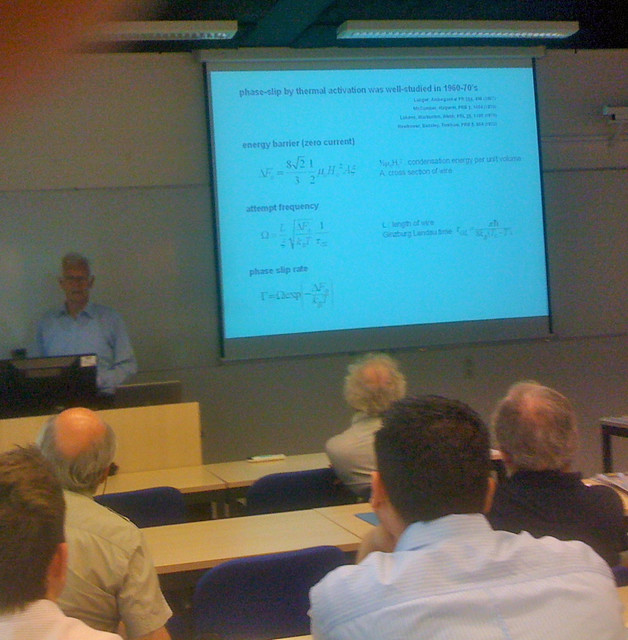
As a summary, it appears that quantum phase slips have been observed. In some wires, there are so many slips that it appears to drive the wire insulating. Whether a wire is insulating or phase slipping superconductor aka a "metal" seems to be controlled by the normal state resistance of the wire. Wires with normal state resistance greater than quantum of resistance for Cooper pairs (6.45 kiloOhms) are insulators and with less resistance are "metal." In Mooij's opinion it is is remarkable that the distinction is so sharp and it is not clear why the division should be set by the quantum of resistance of Cooper pairs, instead of just number close to it.
There is a question from this blogger about the role of filtering. Mooij says that these are high impedance objects and the experiments are incredibly difficult. Believs that experimental results are robust.
Blogged by N. Peter Armitage
Wednesday, May 25, 2011
Strongly Disordered Superconductors and Electronic Segregation
When Kamerlingh Onnes measured on April 8th, 1911 the electrical resistivity of mercury he was interested in the behavior of electrons at low temperature. Will they stay mobile down to the lowest temperature with a resistivity determined by the impurities? Will the resistivity go down because of a reduction of thermal agitation of the atoms? Or will the electrons condense on the atoms and get reduced in number leading to an increase in resistance? Instead he discovered superconductivity in mercury, the sudden decrease in resistance down to an unmeasurable level.
In 2011 there is again a very strong interest in a similar competition between localization and superconductivity. For increasing disorder the resistivity increases, but is sometimes taken over by superconductivity. This is understood as a competition between localized electron-pairing and the establishment of long range phase coherence. Many properties are studied under the label: the superconductor-insulator transition (SIT). Apart from this intrinsically very interesting problem, these disordered superconductors are also very interesting materials to study quantum phase slip processes as well as for use in the detection of faint astronomical signals using compact superconducting resonators. The focus of the workshop will be on strongly disordered superconductors in which it is becoming clear, theoretically and experimentally, that despite of a uniform distribution of disorder the electronic properties become inhomogeneous.
This workshop on "Strongly Disordered Superconductors and Electronic Segregation" being held at the Lorentz Center from 22 Aug 2011 through 26 Aug 2011 brings together a cross-section of experimentalists, engineering-physicists and theorists to discuss the latest results and to identify properties of strongly disordered superconductors to be studied in more detail.
This blog will serve as a clearing house for ideas and a record of the discussions and presentations of this workshop. The hope is that it can also function as a "virtual conference proceedings" in perpetuity.
For details about this workshop in advance, please contact the principal organizers:
M. Feigel'man (Chernogolovka (Moscow region), Russia)
T.M. Klapwijk (Delft, Netherlands)
For details about this blog, please contact:
N. Peter Armitage (Baltimore, USA)
In 2011 there is again a very strong interest in a similar competition between localization and superconductivity. For increasing disorder the resistivity increases, but is sometimes taken over by superconductivity. This is understood as a competition between localized electron-pairing and the establishment of long range phase coherence. Many properties are studied under the label: the superconductor-insulator transition (SIT). Apart from this intrinsically very interesting problem, these disordered superconductors are also very interesting materials to study quantum phase slip processes as well as for use in the detection of faint astronomical signals using compact superconducting resonators. The focus of the workshop will be on strongly disordered superconductors in which it is becoming clear, theoretically and experimentally, that despite of a uniform distribution of disorder the electronic properties become inhomogeneous.
This workshop on "Strongly Disordered Superconductors and Electronic Segregation" being held at the Lorentz Center from 22 Aug 2011 through 26 Aug 2011 brings together a cross-section of experimentalists, engineering-physicists and theorists to discuss the latest results and to identify properties of strongly disordered superconductors to be studied in more detail.
This blog will serve as a clearing house for ideas and a record of the discussions and presentations of this workshop. The hope is that it can also function as a "virtual conference proceedings" in perpetuity.
For details about this workshop in advance, please contact the principal organizers:
M. Feigel'man (Chernogolovka (Moscow region), Russia)
T.M. Klapwijk (Delft, Netherlands)
For details about this blog, please contact:
N. Peter Armitage (Baltimore, USA)
Subscribe to:
Posts (Atom)